Showing posts with label music. Show all posts

25 March 2011

The Trivial and the Ephemeral

While 2000 bands and uncounted hoards have descended on Austin for SXSW 2011, I've had a couple weeks of less exciting but entirely satisfying musical exploration and reflection myself. It started with Loretta Lynn and ended with death metal, so I've covered a bit of ground. There's a lot of great music I haven't heard, and a lot I've heard that I just don't appreciate yet. Seems self-evident, and goes for everyone, but sometimes I just get bored or jaded. Aggressive and open experimentation makes all things new again.

SXSW is about bands, beer, BBQ, and less appealingly, intense navelgazing about the future of music. In a curious keynote, well-spoken has-been Bob Geldof decried the flood of Web music and dished on contemporary American musicians, calling them "smug" and "exhausted," no longer revolutionary or relevant. Critic Greg Kot rightly says Geldof is just not plugged into socially-conscious music, which is of course being made. "Perhaps the deeper issue is not that no one is making that type of music, but that much of it is being lost amid what SXSW executive Roland Swenson called 'the trivial and the ephemeral' culture that is clogging media. The great life-affirming and potentially life-changing revolutionary music that Geldof seeks is being made. But without discerning voices to champion it, who will hear it? Certainly Geldof could use a little help in finding it."

Precisely. Democratization of means of production and broken filters. That's really what bedevils Geldof. He can almost see it, but not quite. He says of social and economic inequality, "What’s music got to say about it? I don’t hear it. Maybe I can’t hear it. Maybe this hyper democracy of the Web simply gives an illusion of talent. You can download a studio. Download any instrument. You can pick up any instrument for nothing. You can make, cut and paste to create fab artwork to make your CD. Everybody has got the means to say anything they want, but nobody has anything to say. We need to talk about it."

"Nobody has anything to say"? Does he only listen to Top 40? So it seems, and top pop is indisputably formulaic and vapid. Jay Frank of futurehit.dna documents at morbid length how totally one-dimensional pop music is. Summed up in numbers, the top 100 songs "account for approximately 36% of all new music track sales. . . . The #1 subject matter in the Top 100 selling songs were variations of 'I want to take you back to my place so we can have sex' songs, accounting for 21% of the top titles. . . . The more traditional subject matter along the same line is the 'I love you' song, which was the 2nd most popular at 17%. These songs just edged out the 'Out Of Love' songs, which accounted for 16% of the titles."

Party songs do well, too, says Frank. Even really bad ones, if they follow the basic pop formula faithfully and can get lucky and go viral. You don't need talent or a label, though ambitious middle-class parents are a big plus. 14-year old Rebecca Black's parents paid $2000 to ARK Music Factory to make a video of her DIY single, "Friday." They posted it on YouTube February 10th, and to date it's attracted over 44 million hits. They quickly put the single out on iTunes, where it's selling 40,000 copies or so a week. The video is bad, it's being parodied, but the Blacks are printing money from it, and Rebecca's bigger than all of SXSW combined. Says Frank, "If you combined every view of 'Friday' and its parody videos, approximately 62 Million minutes were spent on this song [to date!]. . . . In the meantime, if the approximately 15,000 SxSW attendees watched 12 hours of music a day for all 5 days, that would only add up to 54 Million minutes spent watching music."

Rebecca Black - Friday (OFFICIAL VIDEO)

Feel free to cry, as the labels surely are. They've completely lost control of the system. Or if you're Bob Geldof, go ahead and feel validated, because this is future of pop music. Democratic production is here to stay, and it will mostly produce music like this, because this, and Gaga, and Britney, are at the top of the popular taste bell-curve. But at the same time, it permits an expansion of genres that has me buzzing with adrenaline and anticipation.

But if there will be no more Harper Lees, we may likewise see no more Pink Floyds, green and thoroughly non-commercial artists nurtured by generous and patient label A&R into astonishingly vernacular and catalytic talents. Even money-grubbing tastemakers occasionally have good taste, but the labels are losing all power to promote it. Great books only have great power if everybody reads them. Same with music. Revolutionary music proliferates, but out of the vernacular spotlight, buried under the ephemeral, starved of social power. Geldof's assessment is askew, but sadly, only by a quarter turn.

23 February 2011

24-bit Audio on iTunes?

This is so unexpected and implausible that I have a hard time knowing how to parse it. Music industry heavyweight Jimmy Iovine just dropped at an HP news conference that his label (UMG) is working with Apple to introduce 24-bit audio music downloads to iTunes. Standard (Redbook) CD audio and compressed audio formats (mp3, AAC, etc.) are all 16-bit. Heretofore only advanced audio formats like SACD, DVD-Audio, and HD FLAC have supported 24-bit, all of which require special stand-alone players or (usually) upgraded computer hardware and software to play. Current Apple portable players do not even support 24-bit playback, and that limitation is a hardware issue. You'll need a new iPhone. Iovine recognizes this: "we have a long road ahead of us."

Iovine has a twofold interest in this. He's both an industry exec on the content side and a partner with Dr. Dre on the hardware side (Beats Audio), which licenses its branded technology to companies like HP. Selling 24-bit files lets the labels charge more, or a second time, for the advanced format, plus you have to upgrade your hardware to hear it. And you'll want better headphones like, you know, Iovine's own outrageously overpriced Beats by Dr. Dre.

This is clearly just a marketing move, and I can't see how it will get very far, very fast. The biggest practical problem, apart from hardware requirements, is that 24-bit files are huge, on the order of 100mb for a 4.5 minute song. On typical crappy DSL, during peak traffic, you could be a couple hours downloading an album. And your average listener on average equipment won't be able to tell a 24-bit track from an iTunes 256k AAC track, especially with non-acoustic music. If HDtracks pricing holds, 24-bit will cost you $2.50/tr over iTune's current $.99/tr pricing. Not sure there will be many takers. HDtracks is surviving but clearly not thriving, and it is aimed directly at audiophiles who care deeply about audio quality.

At least one recording engineer has already done a takedown of Iovine's idea, saying flatly, "A consumer will never need 24-bit. Ever." I agree. It takes great equipment and ears to hear the difference. This is not a consumer format. And the bigger issue, as he notes, is in the mastering. Iovine and Co. have sucked every bit of dynamic range out of modern pop recordings during mastering to make them "louder," and the main advantage of 24-bit is, yes, more dynamic range that would certainly not be used. I've blogged in the past that good mastering is almost everything, and CD-quality audio is plenty good, even for my picky ears.

    The Beats Audio team have taken the 24-bit concept to the other major labels and retailers, perhaps suggesting they can claw back traditional sales revenue from the growing subscription market, where the likes of Spotify will be unable to compete because the new file sizes will push up streaming time and costs.

As much as I hope this really does take off, it's just marketing. Mp3s are plenty good enough for mobile listening, even if not for critical listening. CD-quality lossless, which can already play on any player, would be entirely adequate for almost any purpose, but that would hardly be what all marketers are looking for—the Next New Hot Thing.

19 February 2011

Six Degrees of Alt Country

I went out to dinner with Tani last night and ended up dissecting for her my conflicted and selective love of country music. It's complicated. There is country music I simply don't like (most of it), and that's not a problem. There is country music I simply love (mostly alt country), and that's no problem either. Then there is country music I like, but am embarrassed to like. That's a post all its own.

Lady Antebellum won the record of the year Grammy for their latest album, which is a perfect example a country music I simply don't like. It's just power pop with fiddle and fictionalized southern sentiment. But I'm also sympathetic to the Philadelphia Weekly's Caralyn Green (um, minus the bit about Ryan Adams), speaking of Lady A's first album:

    I love country music. Neko Case is my goddess. Gillian Welch is my savior. Ryan Adams is my lust-object for life, and Uncle Tupelo is second only to Wilco.
    But Billboard Hot Country chart-toppers/crossover poppers Lady Antebellum? I dunno. It's possible they border a little too country even for me.
    'Cause when I say I love country, I mean I love alt-country. The thing is, even though I adore alt-country, I recognize its hypocrisy. Most alt-country fans, if not artists, are all like, "I dig country, but not, y'know, country."
    That statement's begging for a kick in the head. What we mean is we're down with banjos and fiddles and yearning hearts and vowels that twang, but not with Lady Antebellum's brand of CMT, all-American, Wal-Mart country, and all the Jesus-speak, Old South nostalgia and professed sincerity that accompany the genre. We're distancing ourselves from the folks who drive pickup trucks without irony. And on many levels, that's just elitist bullshit (though I certainly question Lady Antebellum's Civil War allusions and sentiment that "home is where the heart is, just south of the Mason-Dixon Line"). . . .

True enough. If Neko Case is country, I'm a country fan. But if Lady A is country, I'm really, definitely not. Is this a question of elitism? Well, a little. Lady A is radio music for casual listeners, and I rarely like that kind of music regardless of genre. But I enjoy Brad Paisley and Justin Moore and can't wait for Aaron Lewis's new album to come out. That's all country-country, of a certain stripe, but it's also for me a guilty pleasure. Not because I feel some sort of antipathy to rural or heartland culture—I'm a country boy myself, after all—but because it's so overtly sentimental. I shouldn't enjoy having country-country flip my sappy switch, but I do. So there.

Oh yeah, the six degrees. I've posted before about my fascination with the small world phenomenon, that we are all linked together in social networks that are shockingly small. I was just going to post about my very short list of non-mainstream musicians whom I think are truly unique talents. It's not a formal list, but five immediately pop to the top.

Neko Case is number one, and it turns out that she is closely linked to two other of the anointed, Nick Cave (toured with him) and Andrew Bird (recorded with him). And Cave and Bird are definitely not alt country. Six degrees, clearly. Any connection between Neko and Fleet Foxes? Meh, shared a ticket at the Newport Folk Festival. And with Devendra Banhart? Not that I can find. Ah well, my faith in both six degrees and the cosmic connectedness of alt country is nevertheless unshaken.

17 February 2011

Looking Back from the Future of Music (Zune edition)

We've had a Microsoft Zune Pass subscription for over a year. Zune Marketplace is one of the biggest subscription services out there, with about 11 million songs. For $15/mo. you get unlimited "rented" downloads on up to three Zune-compatible devices, and streaming on any PC, plus 10 free tracks/mo. to keep forever. The file quality is great, with 192 kbit/s WMA for streaming and 320 kbit/s MP3s for purchase. The selection is basically comprehensive for the major labels and decent-to-good for indies.

The Zune Marketplace collection is big enough to scratch most itches, and allows you to dig pretty deep with even narrower interests. Here is a selection test I did a while back: There are thirty-five recordings known to me of Rachmaninoff's Vespers, my favorite choral work. Many have been issued on tiny, obscure labels and/or are out of print as CDs. But at least twenty-one of these are available on Zune Marketplace. If you like Gaga or Cee-Lo Green, Zune of course easily has you covered. But even if your tastes are more esoteric, like mine, you are well served. It goes a long way towards putting a universal library of music in your pocket.

The Zune software is great, much better than iTunes. Tani has had a Zune HD for quite a while and has loved it. I just got myself one, finally, and it is the bomb. Best Player Ever, especially at current prices. Great build, great sound, and the best interface on any player. The only thing slightly lacking is its wi-fi performance, but if this were the last music player I ever owned, I'd be just fine. I'd been waiting for the rumored Zune HD2 to come out, but am skeptical now that it ever will. The Zune brand, I just read today, is probably on its way out, at least under that name. The Zune staff has already been reassigned. Future Zune players will either disappear entirely or live on in a different form (as phones or, maybe, portable gaming devices).

And that's the future of portable music players, it seems. Convergence. Nobody wants to own two or three devices (phone, mp3 player, portable gaming device, whatever) when one will do. And everybody already has a phone. Sadly, premium music players are on their way out, as greater segmentation and adoption in the multifunction phone market effectively replaces them. I totally buy the rumors of an iPhone mini.

But subscription music services, and their fantastic value, will keep growing. And what a value. The three of us in our family have played 31,469 tracks on Zune in the past 14 months. If my math is right, that means each play has cost us $0.015, a penny and a half. Even my most-played CD has cost me many times that per play. At retail cost ($15), that means a 1000 tracks would have to be played from a CD to equal the value. Only free would be better. Like Pandora. And in fact, I think the girls would be pretty happy if all they had was Pandora. You can see where this is going . . .

And book publishers still want to charge me $15 to read one of their ebooks once?

15 February 2011

Esperanza

It's 3:00AM. I've been burning it long and low for weeks trying to finish my dissertation before my program ejects me, which it has threatened, nay, promised to do in April. But tomorrow, after years of work, I submit.

But that's not what has me excited today. More that two years ago I posted on Esperanza Spalding, a very talented bassist and a jazz prodigy. She's on my short list of genius überartists who will always inspire me, but will never be popular. Past a certain point, creativity usually becomes prohibitive of popularity. It's transgressive and challenging, and that's not the stuff of entertainment.

But if any of my überartists is going to win hearts and fans, it would be Esperanza. She really works hard to cross over to non-jazz people, and has kilowatt charisma. And tonight she really broke out big, winning the Grammy for Best New Artist (NYT). (New? After three albums?) Apparently this was a bit of a surprise, "the first jazz musician to receive the award in decades, if not ever." She beat out Justin Bieber and was not riding the wave of a hit album.

People just love her, as a person and as a musician. And sometimes the great, banal beast of the Recording Academy just rolls over and gives a great artist her due. Esperanza, congrats.

10 February 2011

Looking Back from the Future of Music (I)

Several months ago I clicked on a featured YouTube video because the screenie showed the headstock of an electric bass. I play (a very little bit) the electric bass and I'm always looking for cool bass videos. This wasn't a bass video, really, but it turned out to be a music video I really liked.


I have no idea who Stephanie Strand is, but looking at her other videos, I'd says she's a 20-something just out of college, in no way a professional musician, but a very talented amateur. She also won the genetic lottery and has a contralto voice that is sweet enough for pop but smokey enough for blues. Her music is just hooky and angular enough to sound fresh while being utterly familiar. She recorded this with GarageTunes, which she admits she's just figuring out (hence the funky drums), and did everything herself with a couple hundred bucks of amateur gear. And it sounds better than a great many studio (over-)produced tracks.

216,534 views of Strand's video to date, and strong comments. I liked one in particular: "You are extremely talented. In another era, recording companies would be rushing to exploit your talent and appeal. You may not be a well schooled musician, but nothing about your performance seems amateurish. To my ears your voice is a striking blend of Karen Carpenter, Billie Holiday, and the French actress/singer Jeanne Moreau."

"In another era . . ." Well, perhaps. But more likely she would never have been discovered by a label. No one but friends and family, or some locals at open mic night, would ever have heard her. She'd never have recorded and been heard by over 200,000 people in just one year. She'd probably never have made a cent on this song or any other. Now she gets Google ad revenue, and she's put Gutters & Drains out as a single on iTunes and Zune. I liked the song enough that originally I ripped the audio stream into an mp3. But now I've bought it off Zune, and I've clicked on her ads to support her. Maybe she's only made a quarter from me at the end of the day, but that's 100% more than she would have made from me just a decade ago.

And that's the future of music. Talented, anonymous people recording songs in their bedrooms, and finding hundreds of thousands of fans. Tell me again why we need the record labels?

As it turns out, even online music stores are tipping into a steep decline. Read this. People aren't even bothering to steal music any more. Now read this. DashGo is an indie music label. A year ago they were getting $25 from iTunes sales for every $1 from YouTube ad revenue. In twelve months that gap has closed to just 2:1. "Every day a few thousand people buy our content on iTunes. Every day on YouTube a few million people stream our songs."

If the music labels thought the death of overpriced CDs sucked, they ain't seen nothin' yet. The paradigms of music distribution are being totally smashed. "It appears if something’s not free, it gets no traction," says Lefsetz. "Used to be it was free on the radio. Then it was free on TV. Now it’s free online. And so ubiquitous that there’s no incentive to buy. . . . YouTube is free. Monetization is being figured out along the way. Maybe we need to admit music is free and work from there."

07 November 2010

Just Too Loud

Much contemporary recorded music sounds absolutely awful, and it has nothing to do with the music itself. The recording industry has been waging amongst itself a loudness war. You may have noticed that of you play an older CD next to a newer CD, the older CD is much quieter. You have to turn up the volume, sometimes quite a lot, to hear it. Louder is not better; it's the sound of war.


All recorded music has a fixed dynamic range, the volume difference between the loudest and the softest sounds. The reason new CDs sound louder is because they are mastered very "hot." All sounds are pushed to be as loud as possible by compressing the dynamic range, even to the pointing of clipping or distorting it. This is sometimes called "brickwalling" since it turns the sound wave into a solid brick of noise.

When everything is made loud, the music sounds flat and harsh, and it's extremely fatiguing to listen to. I suffered from this auditory fatigue for years, listening to newer music, but had no idea what I was experiencing. I just knew there was music I liked that I couldn't stand to listen to for long at all. When I was first made aware of the loudness war, it floored me. Record labels are purposely mastering their music to be unlistenable. For the love heaven, why?

The theory behind all this is that the songs that "jump out" at the listener when they come on the radio, or Pandora, or in iTunes samples, will be the ones they like the most and buy. This is driven purely by marketing. The labels could care less about the music. They have always pushed loudness, but older technologies were prohibitive. With vinyl records, the needle will jump out of the groove if it's mastered too hot. This is one reason why contemporary albums that are released in both vinyl and digital formats sound much better on vinyl. The vinyl is mastered, necessarily, with a lot more dynamic range.

Fortunately, the loudness war has gotten increasing negative press in recent years [1, 2, 3, 4, 5] and Greg Milner's excellent book Perfecting Sound Forever has a great chapter on it. Rank and file fans are slowly becoming aware of it. There was quite an uproar in 2008 when Metallica's Death Magnetic was released. The CD version was mastered insanely hot, but the version used for Guitar Hero was an alternative master (or pre-master) that was much less dynamically compressed. The difference is easy to see and hear, and almost 22,000 fans petitioned for a remaster of the CD. The producers defended their work, refusing to remaster, and most fans probably just ended up torrenting a copy of the Guitar Hero version.

For all this, I don't know that things are changing that much. Most listeners could care less how bad something sounds. Blasted out of crappy computer speakers or throwaway earbuds, everything sounds tinny and clipped anyway. I can still listen to some brickwalled music in small doses, but I'm attracted far more to music that is well recorded and mastered. This has actually shaped my tastes. More on good recordings next post.

29 October 2010

A Dose of Bliss

Bombs from Yemeni terrorists, a looming election catastrophe, Pontiac headed for the guillotine . . . it's all a bit much. Digging around for some soothing music, I ended up listening to some trip hop from more than a decade ago, which in musical terms makes it pretty long in the tooth. But the 90s was bumper season for electronic chill-out music of all sorts. The British made some of the best of it, certainly due to their massive club scene. Trip hop itself is (or was) entirely a British thing.

I find trip hop blissful and dreamy. Some people find it gloomy. Meh, maybe a bit. Make up your own mind. Portishead is probably the best known trip hop artist in the States. Most people have heard at least Glory Box and Sour Times at some point. This live performance completely nails it and has perfect sound. (Long live YouTube!) Massive Attack is, well, massive in Europe, but I only bumped into them last year. "Black Milk" off of Mezzanine features vocals by Elizabeth Fraser of the Cocteau Twins.


21 October 2010

Dizzy

Google gave a graphic shout out to Dizzy Gillespie today on what would have been his 95th birthday (he died in 1993).


I just really discovered jazz about a year ago. After going to a number of concerts and digging into some recordings, I decided it was time to really figure it out. This music that is so compelling but so hard to appreciate. So I watched the Ken Burns documentary (yes, all of it), picked up a couple great books, and started digging into some best-album lists to see which recordings jazz enthusiasts put at the top.

One thing you quickly see is that jazz, from our perspective now, had a brief golden age that produced the preponderance of the top 100 albums. The magic years were from about 1950-65, with it peaking in the late fifties. This music can generally be termed modern jazz, and the varieties developed in the 40s and 50s continue, for all its evolution, to still define jazz today.

The first incarnation of modern jazz was bebop, which changed jazz from dance music (swing) to musicians music. The two main innovators of bebop were Charlie Parker and Dizzy Gillespie. It's because of bebop that jazz today is one of two academic musical genres (the other being classical). It's hard stuff. Hard to listen to and very hard to play. It was created by virtuosos who could not repress themselves, even when people often reacted to their music with shock and dislike. But Gillespie played his music his way his whole life, becoming enormously influential. He is certainly one of the five most important musicians in the history of jazz. The man deserves some respectful thought occasionally, and today was a day for it.

Here's something sweet and cool from Diz.

Dizzy Gillespie Quintet - Tin Tin Deo

01 September 2010

The White Stripes

Most music criticism employs an absurd amount of comparison. So band X is "picking up the Minutemen math-punk thread" but with "screaming MC5 guitars," but can also sound "like a Krautrock Soft Machine" or even "Devendra Banhart piloting Little Feat." (From an actual review.) I'm not going to pretend I'll avoid this. That would be a practical impossibility, because comparison is vital to description. But I want here to start with a band that, for me, is a rock reference point so pure it almost abolishes prior art.

I first heard the White Stripes about five years ago, four albums into their career. I was just getting back into rock after a hiatus. I'd never gotten past the death of grunge or seriously listened to any rock post-Soundgarden. And being old, I didn't have friends exposing me to anything new. I don't recall how I even came across the White Stripes, but I put on their first album, and when it started into "Jimmy the Exploder," I felt like I was just hearing rock 'n roll for the first time. But that sounds quaint. Let me rephrase: It slagged my brain and I've never recovered.


The White Stripes - Jimmy the Exploder

The first two White Stripes albums (The White Stripes and De Stijl) sound like some impossibly successful sound lab experiment to reduce rock to its purest essence. Not in the sense of purely formulaic—it's actually really quirky—but pure in its effects. Those albums communicate to me the raw electricity that rock should communicate. The first one is certainly the purest, and Jack White apparently thinks as much, too: "I still feel we've never topped our first album. It's the most raw, the most powerful, and the most Detroit-sounding record we've made." Subsequent albums are good, but on the whole, decreasingly good. The problem is you can't get purer than pure.


The White Stripes is a two-piece drum and guitar duo, Jack and Meg White. (Apparently once married, though they deny it.) Meg pounds out time on her large tom with ferocious concentration, and Jack lays down raw guitar and vocals over the top. Jack White's influences are Dylan, the Stones, punk, country, and who knows what else, but he's first of all a blues-rock guitarist. Quoth Jack, "I wouldn't trust anyone who didn't love Led Zeppelin." But he's also a devotee of original Delta and Detroit blues, especially Son House, whom he covers with "Death Letter" (on De Stijl), the most electrifying blues track I've ever heard.


I think Jack White is a musical genius. That means at his best there is none better, but also that he is highly restless and erratic. His more recent ensemble experiments with the Raconteurs and the Dead Weather are not especially good. The Raconteurs made a lot of sense, really. Combine Jack White with the superb Greenhornes and you should have jam on toast. But the sum is clearly not equal to its parts.

The White Stripes are often called "garage rock" because of their raw, lo-fi sound, and they became the engine of a garage rock revival centered on Detroit. But I'd call them primal rock, what rock sounds like when it's all talent and instinct and energy, and no production. A lot of rock bands go for that sound, of course, but few succeed. There is no formula here, just eccentric genius. That rare spark was brilliantly visualized by an equally eccentric genius, French director Michel Gondry, who directed the video for "Hardest Button to Button." Best. Video. Ever. (Though you may need Dramamine.)


Bonus content: The Making of.

29 August 2010

Music

I find myself challenged by the very nature of music. I think most people, especially past a certain age, are only casual music listeners. Radio people. Me, I rarely listen to the radio, because most music does nothing for me. In fact, I actively dislike most music. But when I hear music I really like, my brain spasms with a flood of endorphins. Like mainlining pure pleasure. It's literally a religious experience, and I don't know why. That this happens with such wide varieties and genres of music deepens the mystery.

I don't know exactly what makes good music good, but some genres I understand better than others. With mainstream country music, it's the sentimental lyrics and simple sing-a-long melodies. It's done strictly to a formula and the formula works. In fact, as Steve Leftridge has brilliantly argued, it's exactly the same successful formula as classic rock. Alt Country (at least the hard-edged Bloodshot kind) does the same thing, but replaces the sentimentality with punk attitude.

Jazz is all about constant motion, waves of chromatic tones over a highly syncopated rhythm, with an emphasis on free-flowing melody rather than chordal harmony. An instrumental soloist usually leads instead of a vocalist. It's the antithesis of post-40s popular music, which is why most of us can only enjoy it in certain moods and small doses. We're just not acculturated to it.

Classical music is just archaic. I can understand why people don't like it (archaic), but I really don't know why some people do. But there is a profile. Most classical music fans either have played an orchestral instrument, have a lot money, are stereophiles, or are old. Or all of those things.

Rock is simple on paper. Strong backbeat, 4/4 time, drum 'n bass 'n guitar(s), a basic verse/chorus structure, vocals and harmony, and lots of youthful and/or counter-cultural attitude. I mostly listen to rock, so I'm a rock fan, but most rock I hate. Especially when it conforms to the classic rock formula. With some exceptions, the more "rock" it is, the less I like it. Why is that?

The fact is, unlike jazz or country, straight genre rock exhausts the formula very quickly. This is why most rock does not fit the classical rock mold in one way or another, which broadens the scope of the term's meaning until it's almost meaningless. Rock is some kind of consensual genre that no formula can actually define. If I say, "I like rock," that could mean I like REM or Limp Bizkit or the Beatles or AC/DC. All superstar bands, but few rock fans like them all equally, or even like them at all. Whereas few jazz fans love Miles but hate Coltrane.

The fact is, rock music in the round is a highly varied and complex musical form. There is a bewildering number of subgenres, that some artists are quite happy to skip across, and it's always both self-referencing and appropriating influences from the outside. It's a connoisseur's music every bit as much as jazz. For these reasons rock is always surprising me, usually when I've all but given up on it, but finding rock I really like is an incredible challenge. Thirty seconds on Flikr and I can find photographs that thrill me. But I can spend hours reading on Pitchfork and surfing Zune, and still come up with zilch.

This ramble is actually a preamble (pre-ramble?) to some music posts I'm going to start doing, highlighting some bands, or genres, or subgenres, or whatever, that have caught my fancy. Not reviews so much as notices and appreciations. For some reason, I find music criticism the most worthless kind of criticism. I can read a couple movie reviews and know with fair accuracy if I will like a certain movie. But I can read several album reviews and have no idea if I will like an artist or album at all.

I guess (as they say) writing about music is like dancing about architecture, but blogs are read, not heard. Sorry. Right now, it's either that, or all photography all the time.

07 May 2009

Not Your Typical Rock Star

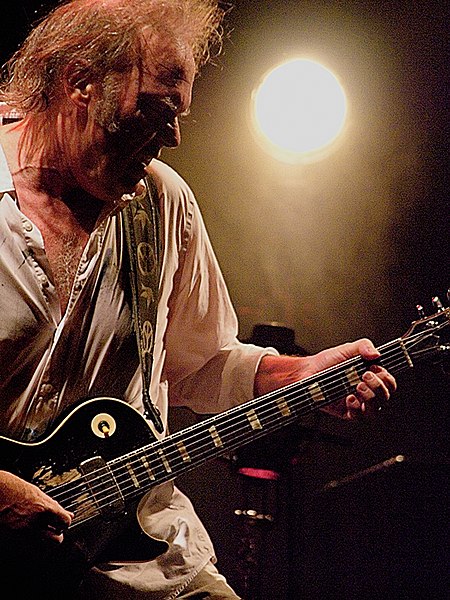
I came across this very recent photo of Neil Young performing and loved it, so I'm sharing.


Not a lot of 63 year-old rock stars out there still laying it down. I've posted on Young before and still think he is an American original. His work with Buffalo Springfield was very influential. When supergroup Rush (also pushing retirement age and still selling out arenas) did an album covering the classic rock that most influenced them, two of the eight tracks were Springfield songs with one written by Young himself ("Mr. Soul"). We took a vacation when I was a kid on which we listened to nothing but a Crosby, Stills, Nash and Young 8-track, and one other tape I can no longer recall. I rediscovered Young as a college student when I heard a track from his MTV Unplugged album on the radio. I bought it immediately. It's still brilliant. Wikipedia says he's sold seventy-nine million albums worldwide as of 2008.

Young's personal musical hero, "the master," is Bob Dylan. Young has received less attention than Dylan, of course, and Dylan at his best is shockingly great. Few would dispute that. But few would also dispute that Dylan is hugely inconsistent. He has bounced back in recent years somewhat (I like "Modern Times"), but for now I'm just an early Dylan fan (at least until a much-needed Rick Rubin-produced album comes out).

Neil Young, on the other hand, is consistently Neil Young. Most of his notable hits were early, but I think his vast body of recording, while genre-spanning, is more of a single piece. Certainly more new work is yet to come, and he is undertaking a huge remastering project of old. But more releases of early boots like Sugar Mountain would be grand.

13 January 2009

More Fleet Foxes

I'm so hip to this album right now that I felt I should post the full imeem stream. Listen, love it, pass it on. (NB: Tracks on imeem playlists are very often not in the album order, even if they include the full album, as is the case here. But hey, whaddaya want for free?)

Fleet Foxes

12 January 2009

Noir, Jim Noir

But no, he is not a private eye. I came across him on an old Best of list from '06, which said of his Tower of Love: "Sure, Jim Noir — the mysterious Mancunian in the bowler hat — has practically cut-and-pasted bits of Pet Sounds into his gentle pop pastiche. But this charming man gets an 'A' for effort. After all, it's actually hard to ape the Beach Boys at their most psychedelic, and Noir's cloudlike choruses and clever couplets stoke pop's eternal flame in a most enchanting way. Plus he did it all himself." I went thence and imeemed him, and indeed, this artist breathes new life into the most flowery sixties pop. He makes want to drive straight to Haight-Ashbury and join in the new Flower Power revival. Take a listen.

11 January 2009

Best Albums of '08: The Black Keys - Attack & Release

I'm only going to do a couple of more "Best of" reviews, and this will be the only one of a band the I do truly love, and have for several years. It's ironic that, as an aspiring bassist, two of my favorite bands are bassless. The other is the White Stripes. (I hear bass lines on this album, but it may be a guitar through an octaver, though Auerbach has recorded with bass before.) Both bands play (or used to play, with the Stripes) stripped-down garage rock blues. One reviewer says, "If Jimi Hendrix had been a white guy from Akron who frequented hipster dive bars, he might have made music like this." Whatever, I like 'em. And Robert Plant likes them, which gives them amazing cred in my book. But I'm not sure this is their best album. I like the early stuff self-recorded in a basement on a Tascam 8-track better. This album is produced by Danger Mouse and sounds a lot slicker, at least by their lo-fi standards. But I'm glad they're getting critical recognition. Warning: My one and only regular reader probably won't like this all that much (sorry, dear).

10 January 2009

Best Albums of '08: Neil Young - Sugar Mountain

Neil Young sounds a lot like . . . Well, I'm sure he sounds like someone before him, but he has now himself become a fixed standard to which others are compared. He is an American original. This is a live album recorded in 1968 just after the breakup of Buffalo Springfield, as he was preparing to launch his solo career. He of course does some Springfield ("Mr. Soul," "Broken Arrow"), but mostly material he would release on his first album, or later albums. Young has always been a stripped-to-the-bone performer, but it doesn't get any more basic than this: Young and his acoustic guitar. It's a great snapshot of an iconic singer/songwriter just coming into his full powers, at the age of 22. If you don't like this, you won't like anything by Young. NPR's Bob Boilen did a great piece on Young and this album that you can read here. And now, the whole album, and in the proper track order (!).

07 January 2009

The Death of DRM

The MacWorld Expo is mostly a platform for Apple to roll out new hardware. They did roll out a new 17" MacBook Pro yesterday, but at $2800, in the midst of economic chaos, I'm not sure it will fly off the shelves. Otherwise, the keynote was a bit of a yawn, all about software revisions (no wonder Jobs chose not to speak). But, the famous "one more thing" at the end was more interesting. DRM will be removed from all songs sold on iTunes (NYT article, Apple).

This was inevitable, but a long time coming. Steve Jobs wrote an open letter to the recording industry in Feb. '07, urging them to do just this. They in fact have not required DRM for music purchased from Amazon, but except for EMI, the labels have retained that restriction for Apple. This has probably been for two main reasons.

First, the labels have hated the iTunes monopoly. With it, Jobs has had them over a barrel for years. By allowing Amazon to sell tracks DRM-free, they have been hoping to build Amazon up as a competitor. And in fact, Amazon has not done badly, but they are no iTunes killer.

But (second reason) they've also finally gotten the big concession they wanted from Jobs: variable pricing for songs. Jobs has been adamant about his 99 cent flat pricing model. But the labels wanted their older back catalog to sell for less (so they could sell more) and their new, hot songs to sell for more (they'll probably sell the same number, but at higher margins). Jobs finally agreed to this and they dropped the DRM.

This is good. DRM is evil. It had to die. But what about all those DRM-poisoned tracks you've already purchased? You can "upgrade" them to DRM-free 256k tracks for 30% of the purchase cost, just as before. Think of it as a format migration. And expect to pay for those songs again and again as new formats emerge. Or, just buy CDs and turn them into whatever you want, whenever you want.

What's next for iTunes? I think lossless music has to be somewhere in its future (yet another format migration). And also a buffet-style all-you-can-hear subscription service, like Rhapsody. Again, Jobs hates the idea, but even he will relent in the face of necessity.

But another real revolution in digital music is social networking services. And here the gorilla in the room is not MySpace or Facebook, but imeem. imeem has licensing agreements with all the major labels that allow users to upload and share music and videos from their artists. And it's free (advertiser supported). Admittedly, this is not a challenge to portable music services, but social networking elements are already incorporated into subscription services. And this is what consumers want: a way to share music (not just playlists) with their friends. Apple certainly knows this and eventually will do it.

06 January 2009

Best Albums of '08: Bon Iver - For Emma, Forever Ago

I admit it, I liked the Bee Gees back in the day, but I've never appreciated falsetto vocals. But as much critical acclaim as this album has received, I approached it with an open mind and surprised myself. The story of the the album's recording has to be part of the allure. Solo artist Justin Vernon retreated to his parents' cabin in Wisconsin for three months to recover from a confluence of personal difficulties: the breakup of a band and a relationship, and poor health. This retreat hadn't meant to result in a recording, but he had the gear and this album was his catharsis. And it sounds like it. The album is less about particular songs than a distinctive style and sound, and an evocative emotionality. I myself will be inclined to listen it only at certain blue times, less for pleasure than for, as was intended, catharsis.


Bon Iver - For Emma, Forever Ago

03 January 2009

Best Albums of '08: Plants & Animals - Parc Avenue

This was not a high profile album and made it onto few "Best of" lists (in fact, maybe only one). But it did receive some critical recognition, as a finalist for the 2008 Polaris Music Prize (an alternative Canandian Grammys), and I really like it. The artists themselves classify their music as "post-classic rock," which I guess means that it's channelling classic folk and rock (the Beatles, Neil Young, the Dead, 60s Brit-pop, and a touch of psychadelic) while remaining thoroughly modern. The same could probably be said for most of today's hot alt-rock. It's a fairly eclectic album, but it all really hangs together well, a harmonious whole. See a fuller review here.


Parc Avenue

29 December 2008

Best Albums of '08: Blitzen Trapper - Furr

Like Fleet Foxes, Blitzen Trapper's Furr owns much in places to the folk rock of Neil Young and Bob Dylan. Now, I have some fondness for Young and Dylan, and I appreciate their unique genius (in fact, I'll celebrate Young's in another post). But I never expected to find this current wave of nouveau folk-pop to be so appealing. I confess, it is. This album did not make it onto all the "Best of" lists, but it probably should have. I especially like the title track, which sounds amazing Dylanesque, from lyrics to vocal style to song structure, but neverthess is fresh and very fetching. But not to mislead, most of the tracks are more retro-rock and folk rock than folk. As evident from the very first track, comparisons with the Grateful Dead are fair enough.